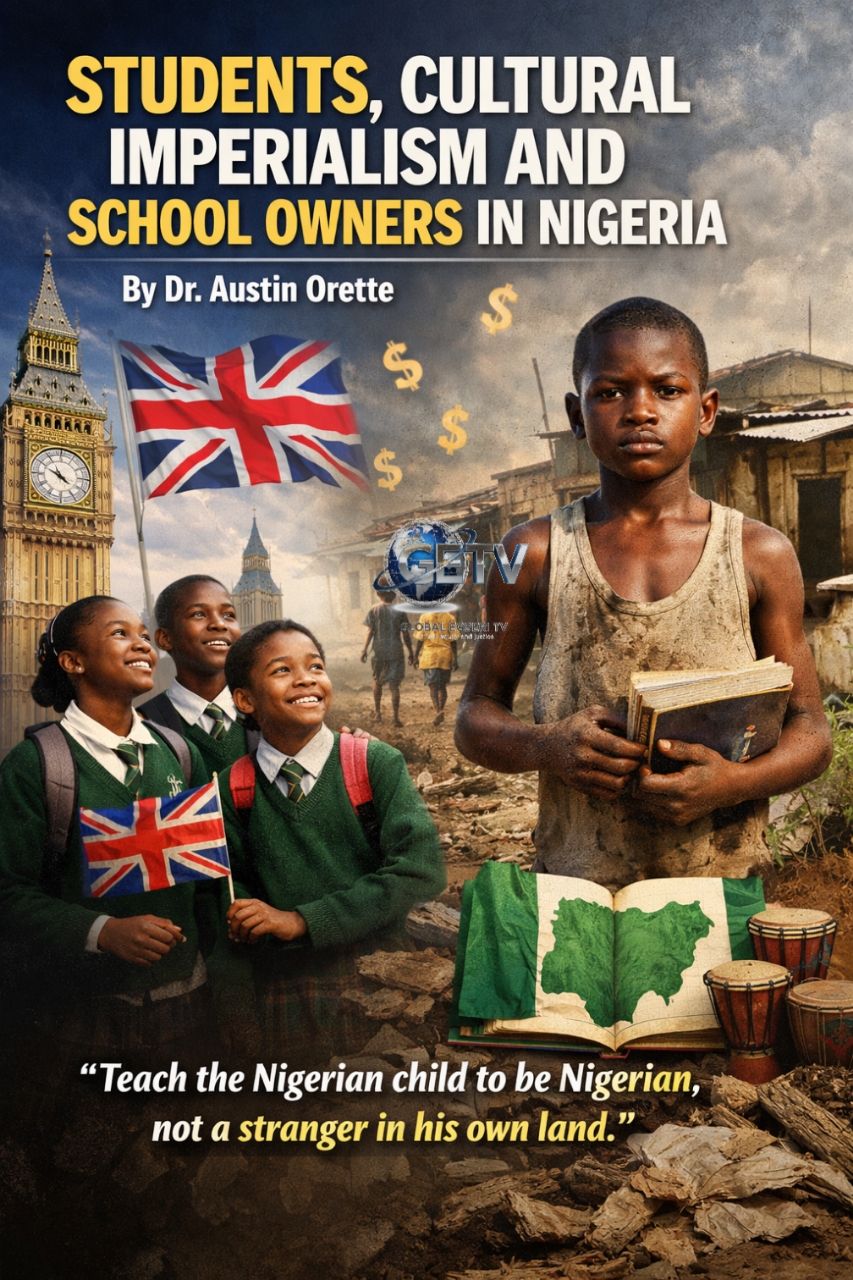
By Dr. Austin Orette
Nigeria’s educational system is increasingly drifting into troubling territory where education is gradually being confused with prestige, social competition, and foreign exposure rather than knowledge, character development, and national consciousness.
Recently, I received a letter requesting parents to pay a significant amount of money for an excursion to England. The request left me deeply disturbed, not merely because of the financial burden it places on families, but because it exposes a deeper crisis within the Nigerian educational system.
At a time when many Nigerian children barely understand the geography, culture, and diversity of their own country, schools are organizing expensive foreign trips under the guise of educational exposure.
What exactly is London meant to teach the Nigerian child that Nigeria itself cannot?
“These children barely understand the geography of Nigeria, yet they are being exported abroad in the name of education.”
One must ask whether we are unconsciously perpetuating a subtle form of cultural imperialism long after colonial rule has ended. Nigeria gained independence decades ago, yet the mindset that anything foreign is superior continues to dominate many of our institutions and social attitudes.
Excursions like these risk reinforcing the dangerous notion that prestige and intelligence are tied to foreign exposure.
In reality, such programs often do little to improve the intellectual capacity of the students involved. Instead, they frequently cultivate a false sense of elitism among children and parents alike. This misplaced pride has gradually eroded the values of humility, service, and national identity that once defined Nigerian society.
Nigeria used to be a place where the children of the rich and poor attended the same schools and shared similar educational experiences. There was less social alienation, and education was designed to prepare young people to contribute meaningfully to society.
Today, that noble system appears to be gradually collapsing under the weight of materialism and social competition.
“What we are witnessing today is not education but the cultivation of entitlement.”
In these difficult economic times, many Nigerian families are struggling to survive. Yet schools are requesting huge sums of money from parents to fund what can only be described as vanity projects.
These trips often serve as status symbols for wealthy parents eager to display their social standing through their children rather than genuine educational opportunities.
For some parents who recently acquired wealth, there appears to be an urgent desire to validate their status through extravagant displays. Unfortunately, education has become one of the platforms where this unhealthy competition plays out.
Children are increasingly being raised not to understand society but to feel superior to it.
As someone who has travelled widely across the world, I can confidently say that many of these trips offer very little educational value. Instead, they often produce the opposite effect: young people who feel disconnected from their environment and alienated from their peers.
“Education should help a child understand himself and his society, not disconnect him from it.”
The deeper tragedy lies in what these practices teach our children about identity. When schools constantly elevate foreign cultures above Nigerian realities, they subtly communicate to students that their own culture, traditions, and environment are inferior.
This mindset is dangerous for a developing nation.
A country cannot build a strong future if its young people are raised to admire foreign societies while disregarding their own.
Education must begin with a clear understanding of one’s environment. The Nigerian child should first be taught what it means to be Nigerian—our history, our diversity, our struggles, and our aspirations as a people.
Instead of flying students thousands of miles abroad, schools could organize excursions that expose children to the real challenges within their own country.
Imagine the educational value of taking students to communities within Lagos and asking them to study issues such as urban poverty, housing challenges, sanitation problems, and sustainable development.
Such experiences would teach empathy, innovation, and civic responsibility—qualities far more valuable than the temporary glamour of foreign trips.
“Service to others is the rent we pay for the space we occupy.”
Unfortunately, the current direction of Nigerian education risks producing generations of entitled individuals who believe the world owes them comfort and privilege.
Many children grow up surrounded by luxury, driven to school in expensive vehicles, attended by domestic workers, and shielded from the real challenges facing society.
When these children eventually become adults, they often lack the sense of responsibility required to build a functional nation.
Parents who wish to take their children abroad are free to do so privately. However, such trips should not be presented by schools as essential components of education.
If this trend continues unchecked, it may become necessary for concerned citizens to formally challenge such practices through the appropriate authorities, including the Federal Ministry of Education Nigeria.
The Nigerian child must be trained to think critically rather than become a passive consumer of foreign cultures that often show little respect for our way of life.
What is most alarming is that Nigerian schools—which should be centers for nurturing responsible citizens—risk becoming incubators for producing disconnected elites who will perpetuate the cycle of national decay.
Nigeria deserves better.
Our children deserve better.
And our educational system must rediscover its true purpose before it is too late.
“Teach the Nigerian child to be Nigerian, not a stranger in his own land.”
Dr. Austin Orette writes from Houston, Texas.
Published by:
Global Egberi Media International
Website: https://globalegberimedia.com
Email: globalegberimedia@gmail.com
Nigeria Contact: +234 813 490 2214





Join the Discussion (0 Comments)