By Dr. Odimientimi Agbedeyi
The global business landscape is entering a period of renewed uncertainty as major economic powers seek to stabilize trade relations, energy markets experience volatility, and financial indices undergo strategic adjustments. Analysts say the convergence of these developments could significantly influence global growth, investment flows, and economic stability in the coming months.
Across major financial centers—from New York and London to Beijing and Tokyo—investors are closely monitoring developments that could reshape global commerce and financial markets.
Renewed Economic Dialogue Between the United States and China
One of the most closely watched developments in the global business community is the renewed economic dialogue between officials from the United States and China.
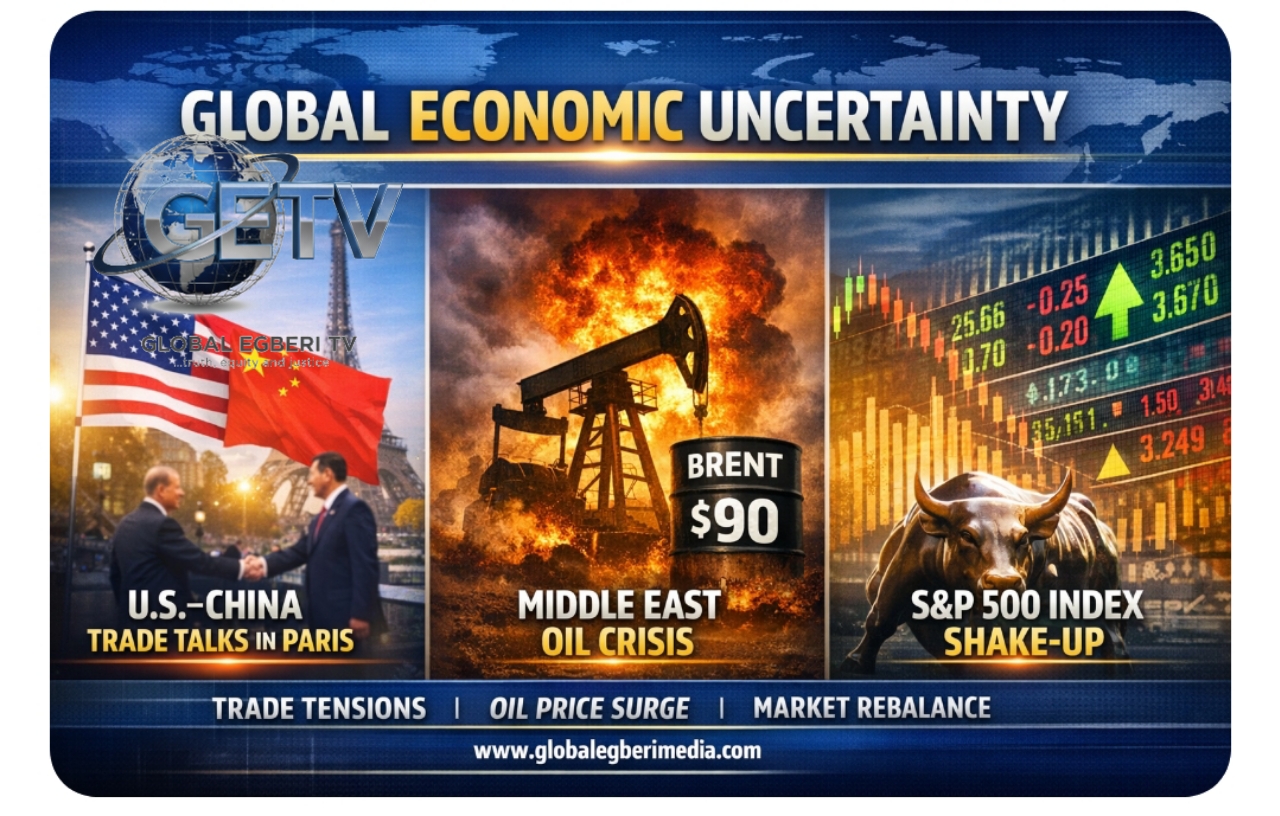
Senior economic representatives from both countries recently met in Paris in a bid to reduce tensions that have characterized the relationship between the world's two largest economies in recent years. The meeting is widely seen as a preparatory step toward a potential high-level summit between Donald Trump and Xi Jinping.
Economic experts say the talks are focused on several critical issues, including:
Trade tariffs affecting billions of dollars in goods
Restrictions on advanced semiconductor technology
Supply chains for rare-earth minerals essential for electronics
Agricultural exports between the two nations
The outcome of these discussions could have far-reaching implications for global markets. Companies in sectors such as technology, manufacturing, and agriculture depend heavily on stable trade relations between the United States and China.
Business analysts warn that prolonged trade tensions could disrupt international supply chains, increase production costs, and slow economic growth in both developed and emerging markets.
However, investors remain cautiously optimistic that dialogue between the two economic giants may help prevent further escalation.
Global Oil Markets Experience Major Volatility
Another major development shaping the global business environment is the sudden volatility in oil markets triggered by geopolitical tensions in the Middle East.
The International Energy Agency recently coordinated an emergency release of hundreds of millions of barrels of oil from global strategic reserves in an attempt to stabilize prices and prevent supply shortages.
Energy analysts say the move was necessary as concerns grow about potential disruptions along the Strait of Hormuz, one of the world’s most critical oil shipping routes.
Nearly one-fifth of the world's oil supply passes through this narrow maritime corridor, making it a strategic focal point for global energy security.
As tensions increased, crude oil prices surged significantly in international markets. Rising oil prices often trigger a ripple effect across multiple sectors of the global economy.
Industries that depend heavily on fuel—such as aviation, shipping, logistics, and manufacturing—could face higher operational costs. These costs are often passed on to consumers, contributing to inflation in many countries.
Economists also warn that persistent energy price increases could delay expected interest-rate cuts by central banks, which many businesses have been anticipating as a boost for economic growth.
Strategic Changes in the S&P 500 Index
Meanwhile, the global financial community is paying close attention to changes in one of the most influential stock market indices in the world—the S&P 500.
The index, which tracks the performance of 500 leading publicly traded companies in the United States, periodically undergoes adjustments to reflect the evolving landscape of the corporate world.
This quarter, several companies are being added to the index after achieving the market capitalization, financial performance, and liquidity required for inclusion.
Being added to the S&P 500 often represents a major milestone for companies because it increases visibility among institutional investors such as pension funds, hedge funds, and asset managers.
Historically, companies included in the index often experience increased demand for their shares as investment funds that track the index adjust their portfolios.
Financial analysts say these changes highlight the growing influence of emerging industries, particularly companies involved in technology, artificial intelligence, renewable energy, and digital infrastructure.
The shift also signals broader changes in global economic leadership as innovation-driven sectors continue to reshape the international business environment.
Global Investors Navigate a Complex Economic Landscape
Taken together, these developments illustrate the complex and interconnected nature of today's global economy.
Trade negotiations between major powers, energy market fluctuations, and changes in financial indices all contribute to shaping investor sentiment and corporate decision-making worldwide.
Despite the uncertainty, many economists remain cautiously optimistic about the resilience of the global economy.
Technological innovation, expanding digital markets, and increasing cross-border investment opportunities continue to create new avenues for economic growth.
However, experts emphasize that maintaining stability will require careful economic diplomacy, sound fiscal policies, and strategic cooperation among major economies.
As businesses and governments navigate these challenges, the coming months will likely prove decisive for the direction of global economic growth.
Sources
Reuters – Global Economic Talks Report
The Guardian – Global Oil Market Developments
Euronews Business – S&P 500 Index Update
Additional reading:
https://www.reuters.com
https://www.theguardian.com/business
https://www.euronews.com/business
Published by: GlobalegberiTV Ofunama – Global Business Desk
🌐 Website: www.globalegberimedia.com





Join the Discussion (0 Comments)